Shipped — Retail and trading
Nexora AI
One system for a retail or trading business — till, stock, suppliers, invoices and books — with an assistant that answers questions from your real numbers.
- 5 → 1
- Tools replaced by one loginTill, stock, purchasing, invoicing and accounts in a single system
- 2
- Languages on the same screenEnglish and Bangla labelling throughout, not a locale switch
- 0
- Figures the assistant states that are not in your recordsEvery answer is checked against the source record before it is shown
- 12
- Delivery phases, each closed with a written exit stateRecorded in the delivery log, with the build green at each one
What it is
Nexora AI is the back office for a retail or trading business. The till, the stock, the suppliers, the invoices and the books are one product with one login instead of five tools that someone has to reconcile by hand.
You can also just ask it. Which products are low on stock? How much do we owe that supplier? Where did last week's margin go? It answers in plain language, from your live data.
Who it is for
Retailers and shopkeepers — one store or several, who need the till, the stock and the accounts to agree without anyone retyping numbers.
Wholesalers and distributors — running purchase orders, supplier bills and stock across more than one warehouse.
Traders and importers — who need invoicing, VAT and a running payables figure without buying an enterprise ERP.
Growing chains of two to ten branches — past what spreadsheets can hold, but not large enough to need enterprise software or the people to run it.
If a business currently runs on a mix of Excel, a standalone till and WhatsApp messages to suppliers, this replaces all of it with one system the whole team can log into.
Why it helps
The numbers stop disagreeing. A sale updates the stock, the cash position, the VAT record and the ledger at the same instant. There is no end-of-month reconciliation because there is nothing to reconcile — the till and the books are the same system.
You find out before it hurts. Stock running low, a supplier balance climbing, margin slipping on a product line: these surface as they happen rather than when someone gets round to checking.
Nobody has to be the person who knows. Owners, managers and cashiers each see what their role needs. When whoever "handles the stock sheet" is on leave, the business does not stop.
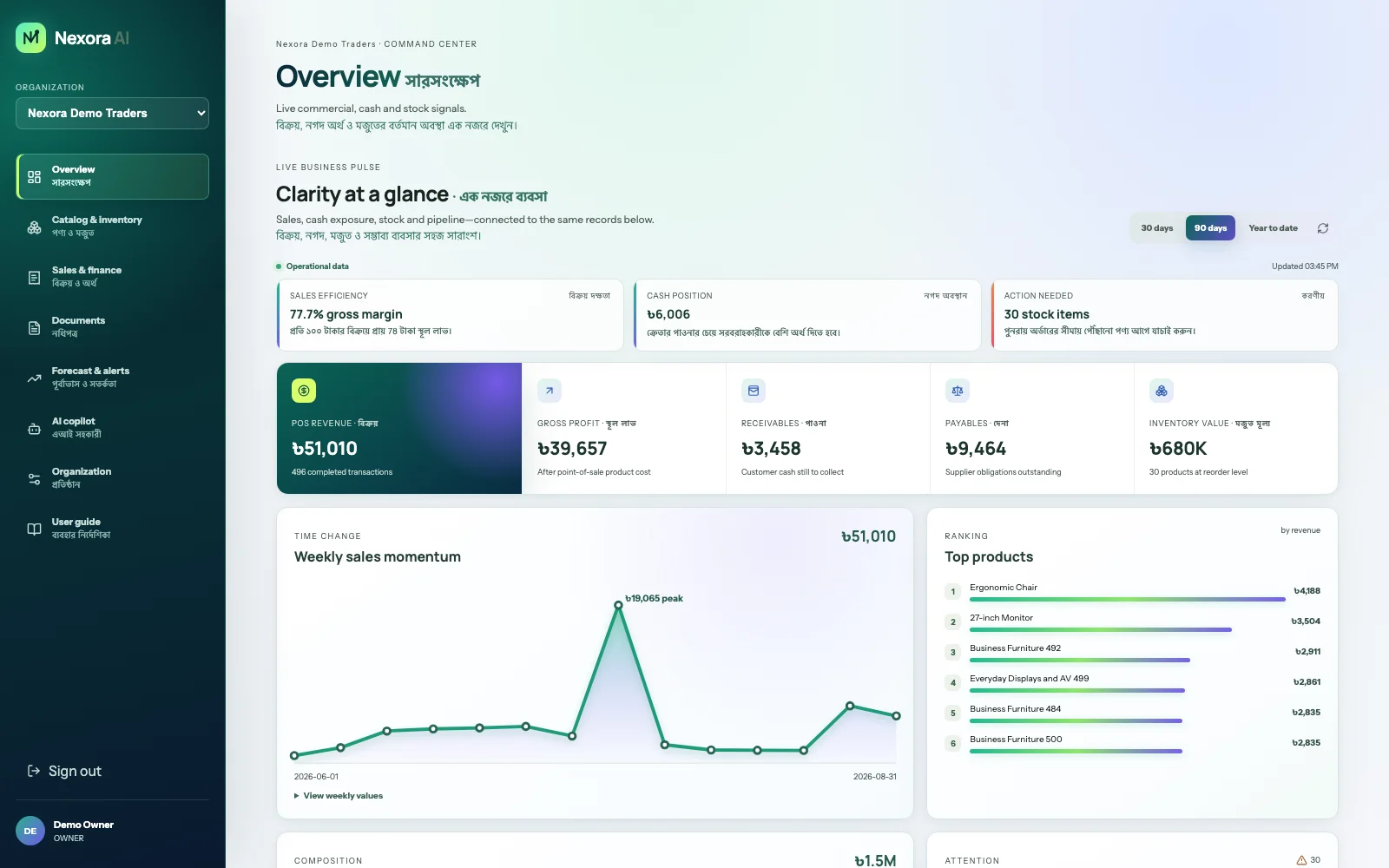
It works in the language the staff use. Every screen is labelled in English and Bangla together — সারসংক্ষেপ beside Overview, বিক্রয় ও অর্থ beside Sales and finance — so a cashier and an accountant can use the same screen without either of them working in a second language.
The assistant does not guess. Ask it about your sales or your stock and every figure it gives back traces to an actual record. It cannot invent a total, and it cannot see another business's data.
What is included
Point of sale. Fast checkout, shift open and close with cash reconciliation, several terminals and branches.
Catalogue and inventory. Products, units and warehouses, with every stock movement logged — so a stock count is auditable rather than a number somebody edited.
Purchasing. Purchase order to receiving to supplier bill to payment, with a running balance per supplier.
Sales and finance. Customer invoicing, payment collection, receivables, and VAT handled inside the flow rather than bolted on.
Documents and the AI copilot. Upload business documents and ask questions about them, or ask about your own sales, stock and finances in plain language.
Multi-branch, multi-user. Role-based access per branch and per person.
Forecasting and alerts. Early warning on stock-outs and demand trends.
How it was built
The commercial promise above rests on one engineering decision: a checkout is a single database transaction. The sale, the stock movement, the payment, the VAT record, the journal entries and the audit event are written together or not at all. A system that can half-finish a checkout is a system whose books are wrong and nobody knows yet.
The rest follows from the same principle. Money is stored and moved as exact decimals, never as floating point, because that is how cents disappear. The stock ledger is the source of truth and the balance is a cache of it, so two tills selling the last unit at the same moment cannot both succeed. Posted accounting entries cannot be edited — a correction is a reversal, which is what an auditor expects to see.
Each business's data is separated by three independent mechanisms rather than one, and that separation is tested by a suite whose job is to break it. Asking for another business's record returns "not found" rather than "not allowed", because "not allowed" would confirm the record exists.
The assistant never writes its own database queries. It chooses from a fixed set of permission-checked tools, and every figure it reports is verified against the tool's output before it reaches the screen.
Seeing it
A walkthrough of the running system is available on request. Tell us how your business works and we will show you the parts of it that matter to you.
- Stack
- Point of saleInventoryPurchasingAccounting and VATAI copilotMulti-branch
Start here
You havesomething thathas to be right.
Tell us what it has to get right and what it is allowed to get wrong. If it is not something we should take on, we will say so and point you somewhere better.
- Reply time
- We reply within one working day.
- Or write directly
- zasif855@gmail.com
- Where
- Dhaka, Bangladesh